
I Am Part of Infinity: the Spiritual Journey of Albert Einstein
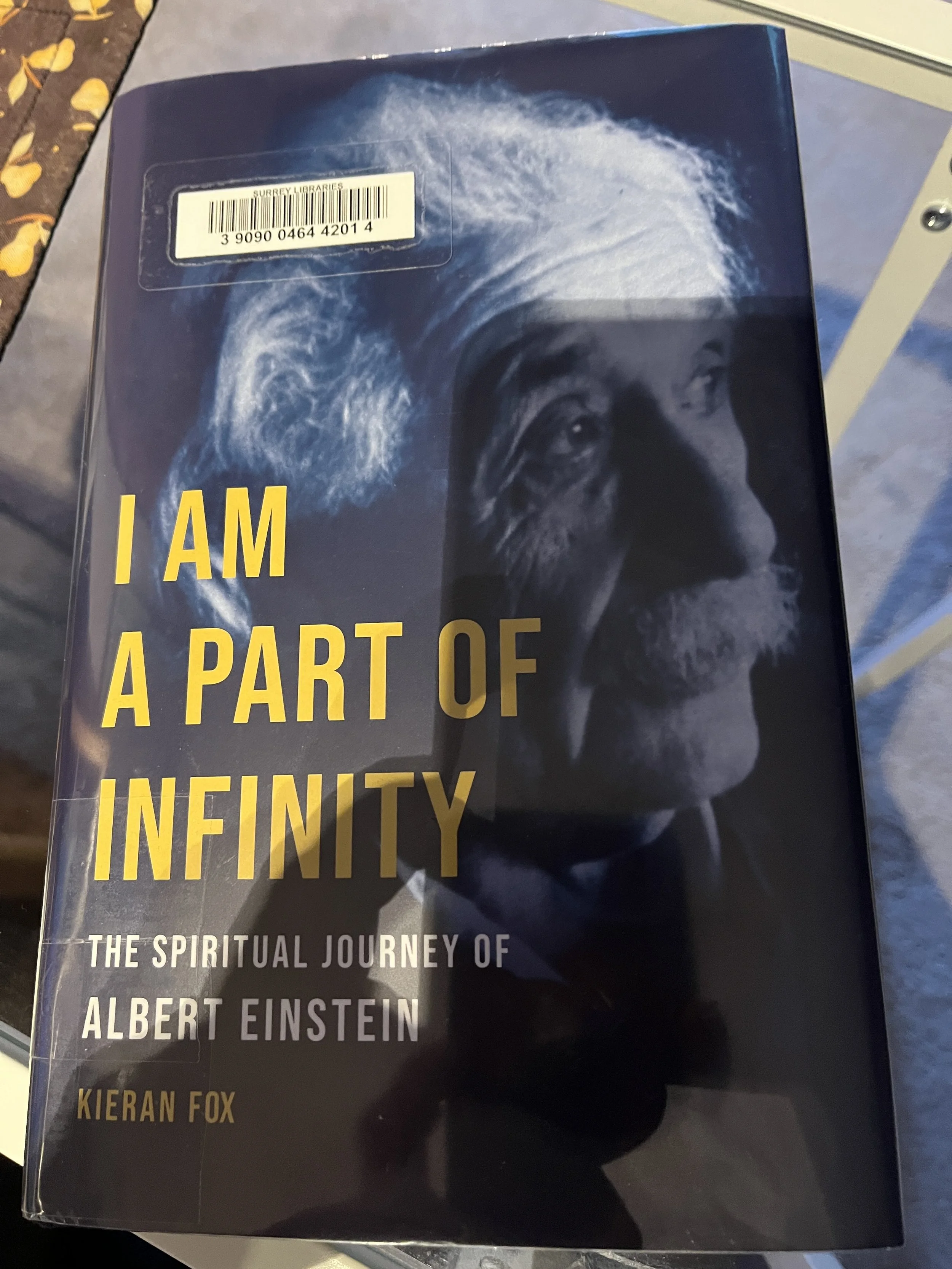
Amazingly, author Keiran Fox was studying to be a medical doctor when he wrote this thoughtful and deeply researched book. In addition to the main idea expressed in the title, it provides a wealth of context for major thinkers and thought of the twentieth century, as well as more ancient thinkers on whose work so many of these ideas are based.
For me, the book provided context for the famous scientists I’d heard of but knew little about. For instance, the 20th century school child’s model of a molecule—resembling electrons orbiting the nucleus as planets round the sun—was based on the work of Nils Bohr.
Einstein’s fellow-physicist and Nobelist Wofgang Pauli was new to me. I found it fascinating that he felt the zeitgeist demanded he keep his spiritual seeking to himself for fear of being thought a crank or dismissed as a madman. Equally interesting was the news that following a breakdown he carried on a long and fruitful philosophical friendship with the famed psychologist Carl Jung.
My Dad loved to tell us kids about thinkers including Pythagoras to Spinoza, but I took no interest in them at the time. This book filled in some surprising background on their lives and ideas.
The mathematician Pythagoras founded schools on Samos, Crete and Croton. He practiced an intensive spiritual practice that included fasting and silence.
The outspoken and misunderstood Spinoza was excommunicated from the Jewish community of Amsterdam. The rabbis expelled, cursed and damned him, as they thought “with the consent of God,” but stopped short of decreeing a death sentence for his failure to conform to their system. Calling his crime “atheism” was an unintended irony. Actually, he believed all things arose from the immanent divine.
A delightful tidbit was the origin and meaning of the Greek word noesis, meaning a way of knowing beyond and independent of the intellect as usually understood. This, of course is the root of the adjective form in The Institute for Noetic Sciences., a connection I had not previously made.
Above all, Fox explains the great man’s radical view of religion, as much as possible using Einstein’s own words. Defining the age he lived in as “barbarous, materialistic, and superficial,” he believed humans hungered for “spiritual nourishment.”
Dismissing “every one of the world’s religions as beyond redemption,” he dreamed of going beyond the dualism that mired them: “body and soul, above and below, Heaven and Earth.” He felt science too mut broaden its outlook and approach.
The new religion would require “a quantum leap in consciousness.” It must recognize that “the physical reality studied by science and the fantastic realms explored by the spirit were really one and the same.” Ethics was part of the new religion, but not in the form of blindly following rules as in traditional religions. In the more evolved human attuned to a unified reality, good behaviour would no longer be motivated by fear of punishment or hope of reward. Instead, the seeker of truth would naturally embody the ethical ideal.
A great admirer of Gandi, Einstein was a pacifist who considered nonviolence a natural corollary of non-dualism. He also felt kindness to all creatures was a necessary “step on the path or moral progress.” It may have been for this reason that he became a vegetarian.