
Did Ye Hear Mammy Died?
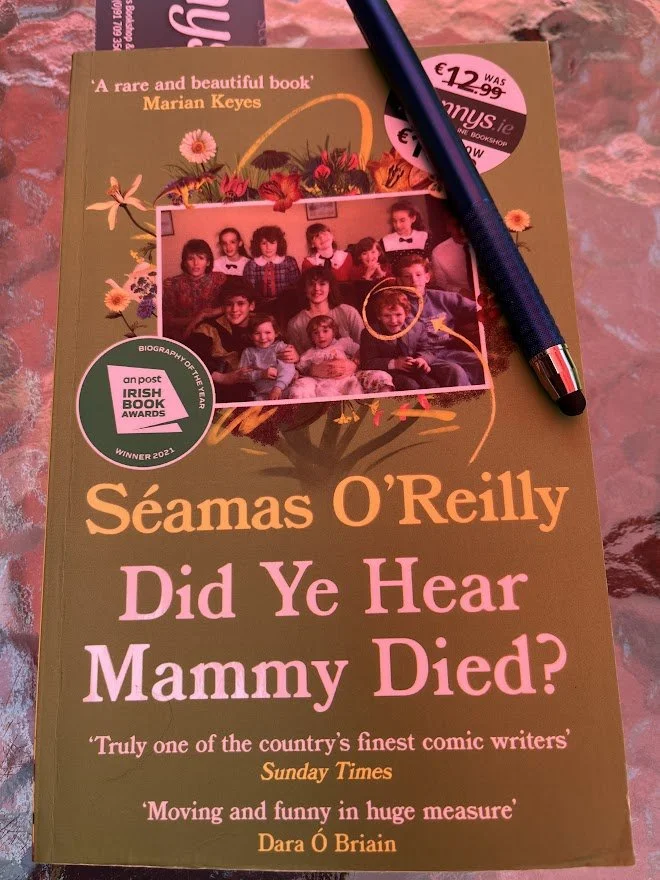
We meet Seamus sporting his new corduroy trousers, an innocent five-year-old who dismays his elders by asking the title question with a smile on his face. It will be a long time before true comprehension enters his little heart. “I knew Heaven was a real, physical place, and I couldn’t visit her there…she’d previously spent time in Belfast, where I could visit her, but it was made clear to me that heaven and Belfast were different in that respect and several others.” To further confuse him, when people tell him it’s great that Mammy’s gone to heaven, it is obvious they’re fighting back tears of intense sadness.
In a celebration of opposites, Seamus O’Reilly’s memoir of growing up outside 1990s Derry with his Dad and ten siblings veers between poignant and hilarious. His use of language is superb and the metaphors at times downright loony, as when he tells of the enormous Christmas turkey that is too small to be cooked in the oven at home. “The size of a Fiat 50…it was the kind of thing you could imagine being taken out of the oven by a forklift, rather than a kindly nun.” The nun in question, the burly Sister Angela, we are told, “had a smile that could melt glass and forearms that bent steel.”
His teacher tries to support the wee half-orphan by standing in front of the class holding his hand and announcing that his mammy has just died and therefore he is very sad. With her commanding aura, Mrs. Devlin is “one of those indomitable older women that you could imagine spending her bank holidays in a a small static caravan in Donegal, doing thousand-piece jigsaws of Padraig Pearse, or knitting balaclavas for the Provisional IRA.”
She pats his head nervously, evoking the adult teller’s memory of being “still very much unenthused by physical affection,” though the funeral celebrations have seen him “passed around like a stress toy for the preceding two weeks.” His classmates commiserate, then begin asking probing questions regarding whether his Mammy will bring back presents from Heaven, like a Toblerone, when she comes back.
The family of eleven children were loved, cared for and raised by their Dad, on whom they doted. “One legacy of the Troubles for people my age,” the author tells us, is that they can’t attack their elders “for being grumpy and churlish, since back when they were kids, they were all being stopped by police four times a day or dragged out of their homes by soldiers at 4 am for having the wrong surname.”
Seamus’s mother was buried in Brandywell Cemetery, near Creggan and overlooking Derry City’s stadium. Some years later “a fibreglass statue of a paramilitary volunteer was erected a few graves in front of hers.” Now, whenever he visits his mother’s grave, “it hovers on the edge of” his vision, “a heavy-handed visual metaphor for how large a shadow the Troubles cast over Northern Ireland” during his childhood.
That selfsame childhood provides plenty of comic fuel to counterbalance the sadness. In one hilarious scene, a priest called Father Balance is called to the house to bless the family’s new caravan. Arriving on a foggy morning, complete with incense thurible, he finds himself hounded by the family’s “possibly Protestant dog,” described as “less of a beloved pet than an uncaring brute that tumbled through our lives like a demented frat boy in an American campus comedy.”
Before Mammy dies, the size of the growing family engenders surprise, even among Catholic friends. Though his mother loved having children, she also “lived in the modern world, and understood that as the numbers accumulated, each happy announcement might provoke greater surprise.” The births of the last half-dozen transmutes this feeling into “naked incredulity.” However, this also grants the widowed Daddy special consideration when he is left in charge of the enormous brood. Since Joe Reilly’s children are well-cared for and well-behaved, the schoolteacher lets him off signing the daily behaviour reports the school sends home to parents.
Looking back on his childhood, Reilly muses about how much of our homeland’s values we unconsciously absorb and carry through life. Observing that “fuss, in all its forms, is like kryptonite, to Northern Irish people, he recognizes as a middle-aged man with his own family in Hackney, that this attitude of avoiding fuss is deeply “baked in.” After all, he concludes, “we…lived through a period in which 10% of us lost an immediate family member to political violence and saw fit to call this the Troubles, as if it were not a brutal cycle of spiteful bloodshed but rather a period of intemperate hailstorms, or a breakdown in the country’s system of planning applications.”
At the end of the book, the author returns to the bizarre question asked by his five-year-old self, and shares a little of its long-lasting psychological impact. Unable to process the grief for his mother at the time of her death, he buried it for a time, dealing with it afterwards through periods of depression that required a series of “controlled explosions” to set him free. After a bout of insomnia and violent crying a couple of years after her death, he had an emergency appendectomy. When he woke up in the hospital, his father had rushed off to fetch a book his son wanted brought to the hospital. Thus he woke up to the sound of three women visitors chatting and telling him his Mammy was “a real lady,” and God putting her on earth was “only spoiling us.” Lulled and strangely consoled by their words, he slept again.
In his particularly Irish way, Sean Reilly shuttles his readers between tears to laughter, at the same time conveying a strong sense of the time and place of his growing up and how it influenced his life.